GA for Neural Network Pruning
Evolving structured pruning masks for a FashionMNIST MLP while keeping its trained weights frozen
Can evolutionary search remove most of a neural network without retraining it?
This project studies that question on a 784 → 256 → 256 → 256 → 10 ReLU MLP trained on FashionMNIST.
Method

The experiment follows four steps:
- Train and freeze one model. AdamW trains the MLP for 10 epochs using a fixed 30% validation split. The checkpoint with the lowest validation loss is retained.
- Encode a compact pruning mask. Each chromosome contains one bit for each of the 768 hidden neurons. A zero disables that neuron and all connections that depend on it, so the result can be materialized as smaller dense layers.
- Evolve masks at an exact sparsity. A population of 100 masks undergoes tournament selection, crossover, bit-flip mutation, exact-cardinality repair, and elitism. Every method receives the same 25,000 mask evaluations.
- Separate selection from evaluation. Full validation accuracy is the fitness function. The test set is used only once, after the best mask has been selected. Results aggregate five mask-search seeds and compare the GA with equal-budget hill climbing, random search, and neuron-magnitude pruning.
Results
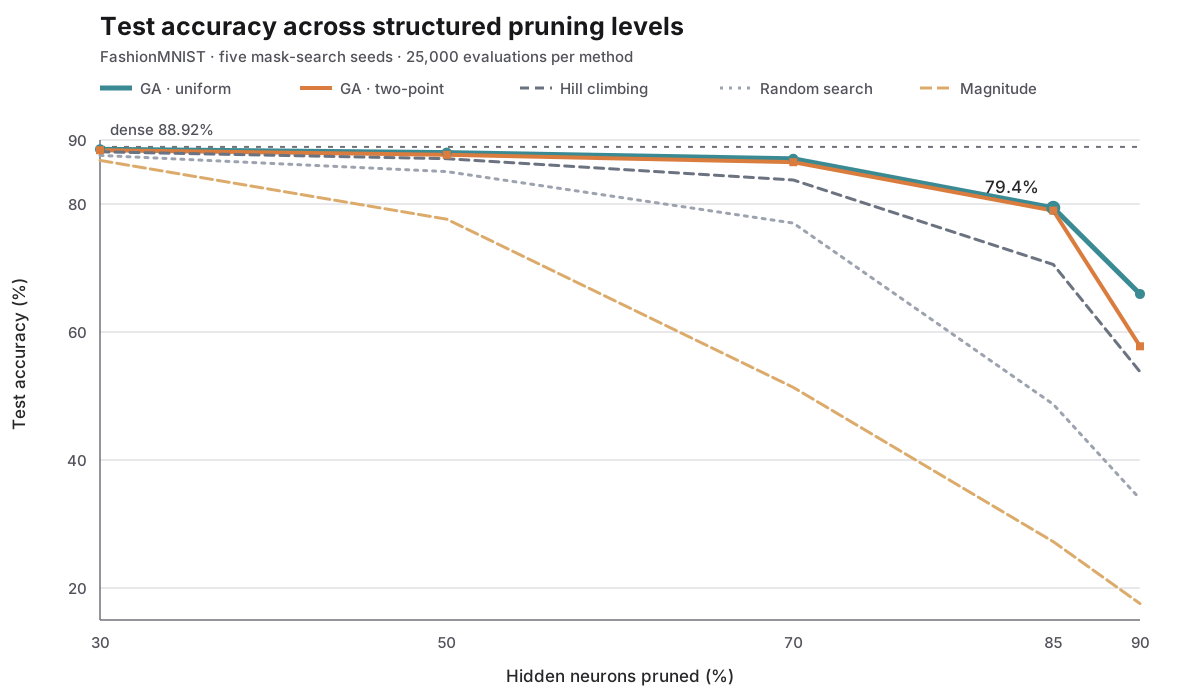
At 85% neuron sparsity, uniform-crossover GA retains 79.4 ± 3.0% test accuracy, compared with 88.92% for the original dense model. That is 8.9 percentage points above equal-budget hill climbing, 30.7 points above random search, and 52.2 points above per-layer magnitude pruning. The gap grows as the pruning constraint becomes harder: at 90% sparsity, the GA retains 65.9% accuracy versus 53.8% for hill climbing.
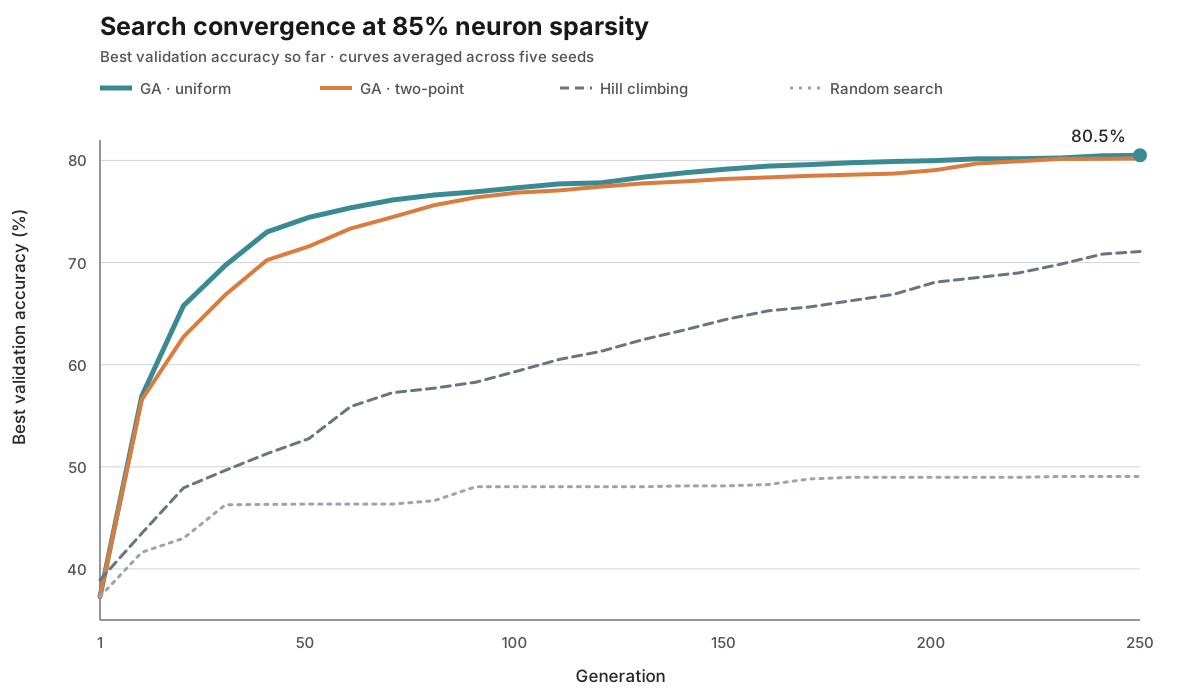
The convergence curves explain the final gap. At 85% sparsity, both crossover variants keep improving throughout the search, while random search plateaus early and hill climbing advances more slowly. Uniform crossover finishes slightly ahead of two-point crossover.